
Collaboration between CSTAT and circadian biology researcher identifies new biomarkers and improved management strategies to improve pregnancy outcomes in women
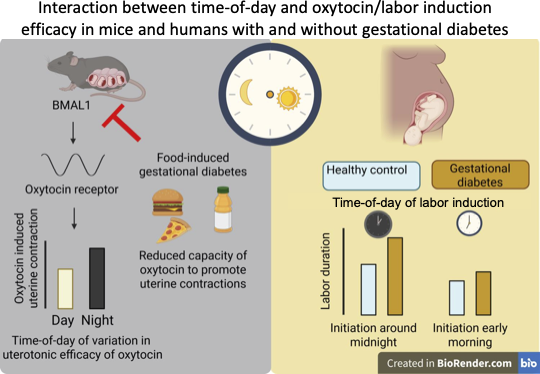
By utilizing data mining and large-scale retrospective analyses of hospital records, the partnership between Dr. Zhou at CSTAT and Dr. Hoffmann in the Department of Animal Science (CANR) has uncovered new strategies to improve maternal outcomes. A key finding of this work is the discovery that labor induction timing significantly affects labor duration. Their analysis of over 2,300 patients revealed that starting induction in the morning rather than at midnight can shorten labor by approximately seven hours for women with gestational diabetes.
Beyond clinical records, the team also uses bioinformatics to identify molecular biomarkers for pregnancy complications. This approach led to the identification of specific circadian genes in maternal blood that, when expressed at low levels in the second trimester of pregnancy, are associated with a five-fold increase in the risk of spontaneous preterm birth. This study was honored with the 2021 Biology of Reproduction Most Popular Research Article Award.
Van-Quynh Duong T, Yaw AM, Zhou G, Sinha N, Cherukuri AS, Nguyen D, Cataldo K, Ly N, Sen A, Sempere LF, Detrie C, Seiler R, Olomu IN, Cortese R, Long R, Hoffmann HM. Interaction between time-of-day and oxytocin efficacy in mice and humans with and without gestational diabetes. Mol Metab. 2026 Jan;103:102269. doi: 10.1016/j.molmet.2025.102269. Epub 2025 Oct 16. PMID: 41109427; PMCID: PMC12902303.
Zhou G, Duong TV, Kasten EP, Hoffmann HM. Low CLOCK and CRY2 in 2nd trimester human maternal blood and risk of preterm birth: a nested case-control study†. Biol Reprod. 2021 Oct 11;105(4):827-836. doi: 10.1093/biolre/ioab119. PMID: 34142702; PMCID: PMC8511660.